
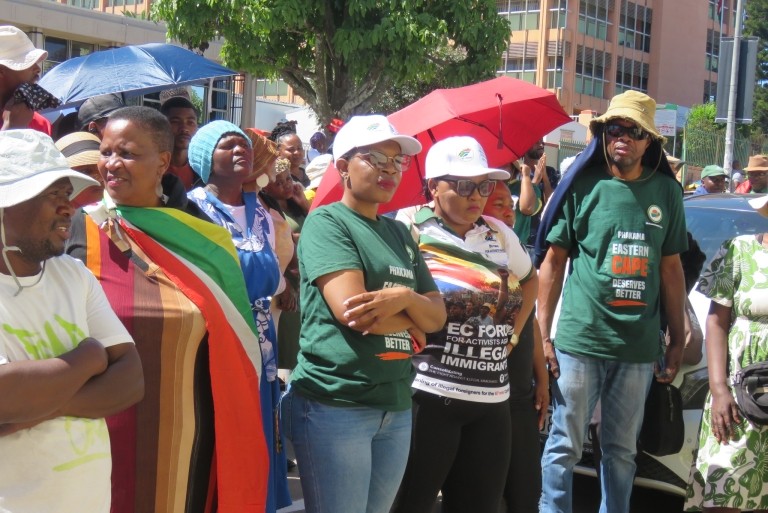
MTHATHA, Eastern Cape — The Phakama Eastern Cape Movement has called on traditional leaders to take a more active role in addressing the settlement of foreign nationals in rural communities, following a protest outside the Department of Home Affairs in Mthatha on Friday, 9 October 2026.
The march took place amid heightened national tensions over asylum applications and immigration enforcement, following the Department of Home Affairs’ withdrawal of a directive requiring refugee reception offices to accept asylum applications in accordance with a Constitutional Court ruling.
Phakama says traditional leaders must act
Phakama Eastern Cape Movement leader Phiko Adonis said the demonstration was intended to oppose the department’s directive, which allowed asylum seekers to submit applications for refugee status from 5 October.
“We are here to say this is not going to happen in our country,” Adonis said.
He maintained that the movement would continue opposing the directive even after its withdrawal, adding that its concerns about foreign nationals predated the court judgment.
“We have seen them standing in long queues over the past two days and it was only men. Where are the women and children?” he asked.
Adonis called on traditional leaders to become more involved in regulating settlement in rural communities.
“Permission to enter rural areas lies with traditional leaders,” he said.
He alleged that foreign nationals had taken over businesses in some areas and raised concerns about people living in South Africa without valid documentation. These allegations have not been independently verified by ECNewsLive.
Residents raise concerns over identity documents
Mthatha Hawkers Association deputy secretary Nolizwe Mthethelwa raised concerns about South Africans experiencing difficulties obtaining identity documents from Home Affairs.
Mthethelwa said she was assisting three people who were struggling to obtain their IDs because of problems with the department’s system.
“I have three people that I am trying to assist so that they can get their IDs, but it is hard to assist them due to the system of this department,” she said.
She questioned why South Africans’ documentation challenges had not been resolved before the department began processing additional asylum applications.
“If it is that easy, they (the department) must sort the problems facing our people first,” Mthethelwa said.
Her remarks highlighted concerns about access to essential government services, although the claims about the comparative treatment of South Africans and foreign nationals were not independently established.
Home Affairs withdraws asylum directive
The protest coincided with the department’s decision on Friday to withdraw its directive concerning the processing of asylum applications.
Home Affairs said the directive had placed significant pressure on refugee reception offices within days of implementation, putting officials at risk and raising serious concerns about public safety and order.
The directive followed a Constitutional Court judgment delivered on 7 July 2026 concerning procedural barriers to asylum applications.
The department said it would develop a revised operational approach to comply with the judgment while addressing the practical challenges experienced by refugee reception offices.
The ruling does not automatically grant refugee status to asylum seekers. Applications must still be assessed through the established refugee status determination process.
Eastern Cape police placed on high alert
Eastern Cape police spokesperson Brigadier Nobuntu Gantana said provincial police had been placed on high alert following unrest in other provinces and developments surrounding the Home Affairs directive.
“In response to the earlier developments, Provincial Commissioner Lieutenant General Vuyisile Ncata instructed all District Commissioners to be on high alert,” Gantana said.
She said police were monitoring potential hotspots and key public areas across the province.
Gantana also warned that criminal conduct during protests would not be tolerated.
“Acts of criminality, including blocking of roads, looting, damage to property, intimidation of the public, and attacks on police officers, will be met with firm and decisive action,” she said.
Police reported that a protest outside the Home Affairs office in KuGompo City was managed without injuries, arrests or property damage.
In Gqeberha, officers used stun grenades to disperse a group outside the Home Affairs office after protesters failed to comply with police instructions.
Police said the Eastern Cape remained calm while officers monitored strategic locations.
ECNewsLive will continue monitoring developments surrounding the Mthatha protest, the processing of asylum applications and access to Home Affairs services.